
CYCLING IN THE FRENCH ALPS
The 21 bends, the high giants and how to plan a first Alpine trip.
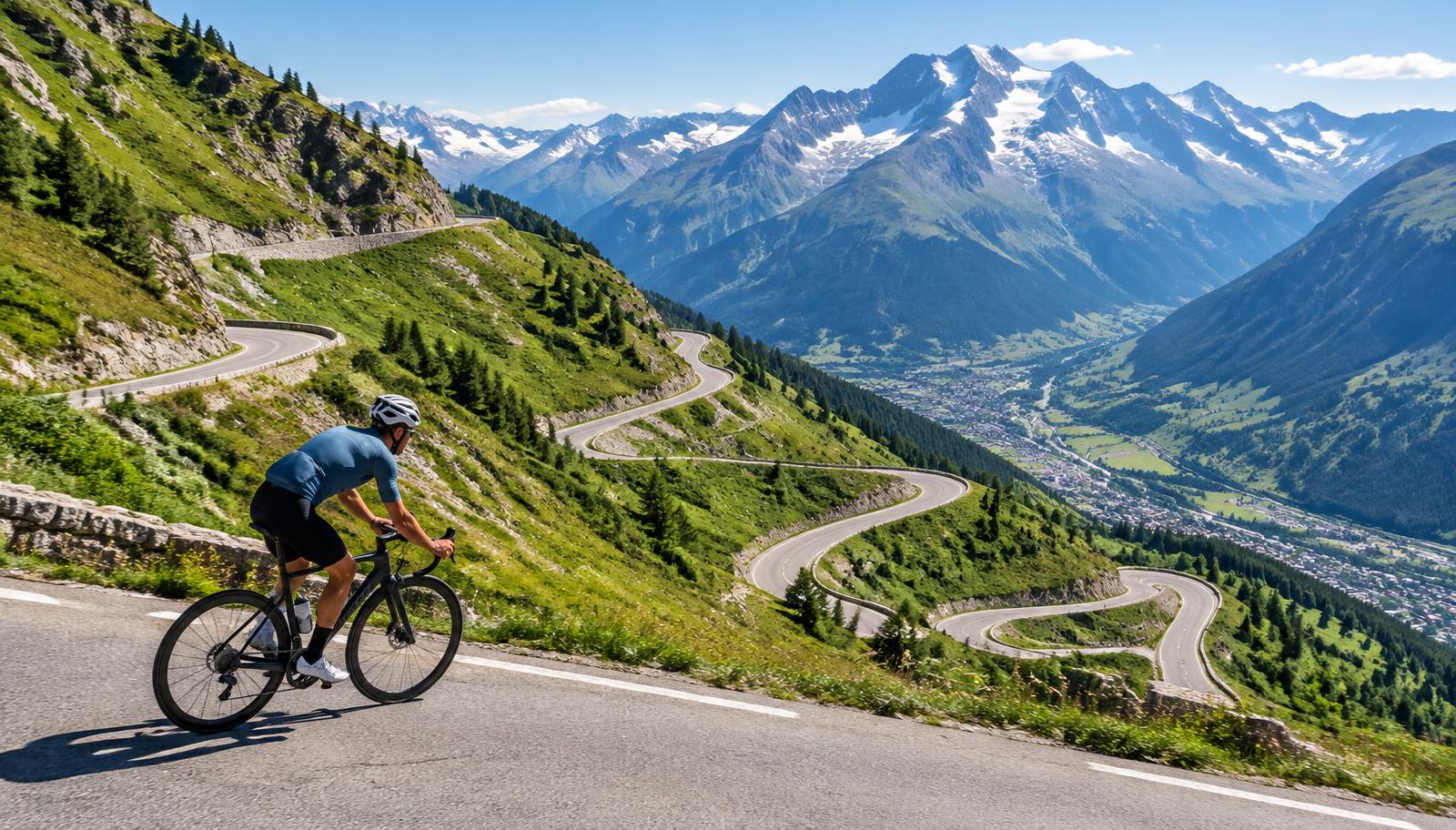
WHY THE FRENCH ALPS
This is Tour de France country at full scale: deep valleys, climbs that gain more than a vertical kilometre, and summit roads above 2,000 metres. Bourg-d'Oisans puts the most famous bend markers in cycling directly outside your door.
THE ICONS
| Climb | Character | The warning |
|---|---|---|
| Alpe d’Huez | 21 numbered hairpins | The opening ramps are the steepest — do not chase them. |
| Col du Galibier | High, long and exposed | Weather and altitude matter as much as gradient. |
| Col de la Croix de Fer | Long and irregular | Descents inside the climb disrupt your rhythm. |
| Col du Glandon | Wild and steep near the top | Save a gear for the final kilometres. |
Elevation is sampled between climb endpoints rather than along the road’s bends; displayed distances and gradients are indicative, not a GPS trace.
WHERE TO BASE YOURSELF
Bourg-d'Oisans
The obvious first base: Alpe d'Huez begins in town, while Croix de Fer, Glandon and the road towards Galibier are all within reach.
Saint-Jean-de-Maurienne
A stronger choice for riders prioritising Galibier, Croix de Fer, Glandon and the western approaches to the Maurienne giants.
PRACTICAL NOTES
- Use genuinely low gearing; long climbs magnify every ambitious choice.
- Descents can be cold even when the valley is hot, so carry a packable layer.
- Check pass conditions before leaving — storms and road works can close high roads.
- Spend band: mid-range, with apartments often better value for groups.
FAQ
Is Alpe d’Huez suitable for a first Alpine climb?
What is the best month to cycle the French Alps?
RESPECT THE FIRST FIVE MINUTES
Alpine climbs punish early enthusiasm. Train controlled threshold blocks and learn the power you can actually hold for an hour.